

Good news, patrons! The beta for the JOKKA! game is now open! You, as paying patrons, now have early access!
Going back through the earliest conversations about the development of JOKKA! Made me realize that… they were conversations. I didn’t know how strange this was until I started reading and researching gamedev, because inevitably there’s a chapter about alpha testing. It always starts with something like “Here’s how you find alpha testers!” and “here’s how you collect data!” and “here’s how you reconcile user feedback with the game you’ve spent months developing in your fortress of solitude!”
What was I doing from the very beginning? “Look, here’s my toy! It’s online! Come poke it!”
Obviously, this is an artifact of having chosen to develop a web-first game; it’s a lot harder to have this kind of interaction if your game is desktop or console-based. But I did what I did, and because of that, from the very beginning, I was working with alpha tester feedback. There are conversations with 10+ people asking me questions, reporting something weird, telling me what would be fun and what would be awful, reacting to my plans. This is, I’ve come to understand, not the usual way you develop a game.
It was a lot of fun, though.
The biggest and most obvious pitfall of doing this is dilution of your vision, which is just a fancy way of saying ‘you let other people pull you in too many directions, most of which have nothing to do with what you wanted in the first place.’ But I am stubborn, and I never felt obliged to implement every suggestion I heard. I picked and chose the ones I liked, discarded the ones I didn’t, and listened to the problems and concerns with particular interest.
But what a gold mine user feedback is!
What would the game have been like had I not been operating with continuous user feedback? I have no idea. But I probably would have created something cool, sprung it on a bunch of people, and then gotten swamped with everything from minor issues (“I can’t make a name with an apostrophe in it!”) to game-breaking (“this is boring”).
To wind things back in time, the early toy involved breeding characters and seeing how the offspring turned out. This was the point where I confronted the question: “So what?” Many pet-collection/breeding games have more mechanics than ‘pair off two characters, get a baby’, so what did I want to do afterwards? I had multiple conversations with my players about this; I said in one conversation: “The recursive loop was always “make more puppets and dress them” but I begin to worry about the art workload.”
Which led to “…it would have to be fun in some other way besides breeding at that point.”
This, I think, was the moment when the game design began to pivot. Looking back at it now, I thought I was building Flight Rising, Wolvden, Lioden, and would continue to think so for a long time.
What I’d actually be building, though, was Dwarf Fortress.
But for now, it was still a toy.
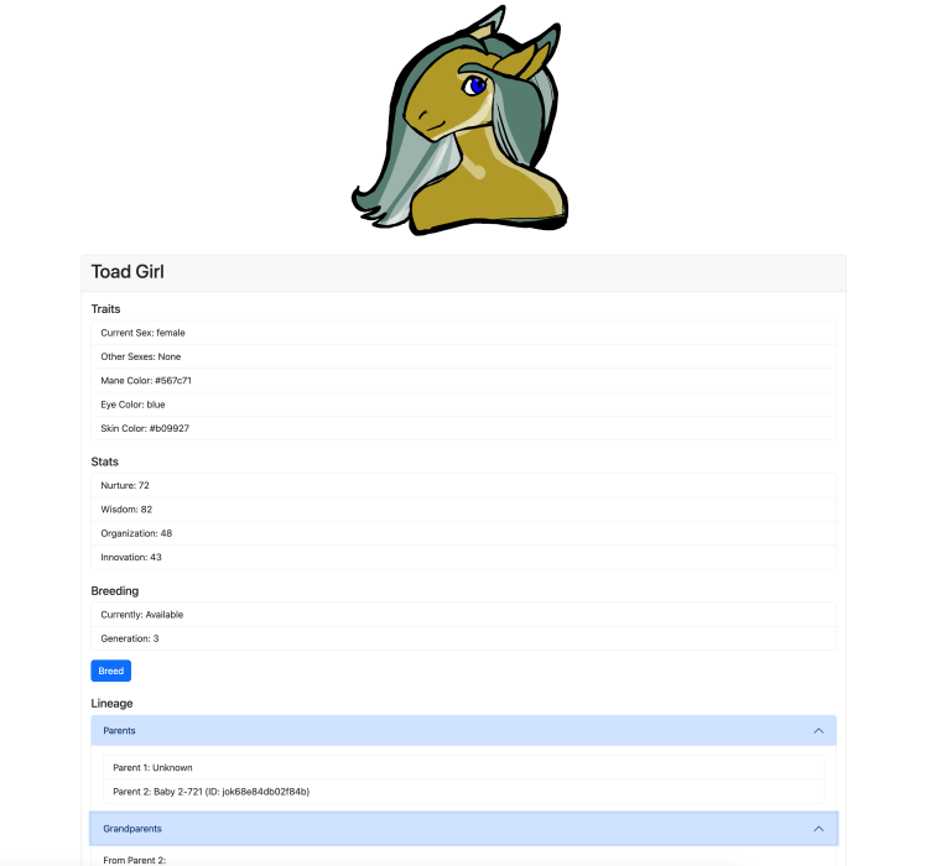
“I have a clan page that loads everyone, lets you rename, release (delete), and click-to-breed. Clicking on the character takes you to the character screen. And then there's the cavern screen where you can do the actual breeding and getting the baby. And all of it works! I guess even if it never gets much more complicated, it might still be fun. Like... maybe I can think 'it's okay to settle for wordle, you don't have to build multiplayer MMO scrabble.'”
Yeah, yeah. Keep telling yourself that, Jaguar…!
Or at least, I intend it to be relaxing. Hopefully it delivers.
4:22 minutes
Materials:
In which I talk about the paper, the paint, and the experience of oils versus gouache. Fun stuff, will do more.
Thank you Locals supporters! Your contribution to my art war chest here is what's powering these experiments and videos. For now I'm keeping them public but I may start doing some subscriber-only videos if you all are interested.💖
Thanks for your comments yesterday on the business post... all very provocative, in a good way. I'll try to respond to all of them today.
Some Alysha misc now, since I'm gearing up for the results of the Kickstarter!
Petrov is giving away coupon codes for every book in the Alysha series (and has some leftover coupons for Marda and the business book). You can pick those up here (and please do! The books are bought already, someone should use them!) https://twitter.com/PetrovNeutrino/status/1457344535843987461
Our own @JudasComplex sent along a sample of the Faith in the Service audiobook, which I've attached for your delight! I... haven't had a chance to listen to it. Don't ask me about my past week and a half or so. Putting it here will guarantee I get to it.
After hearing the amused comments during the livestream, I went ahead and added all the ship type illustrations I have inked from the 90s to the wiki. Glory in the rampant adorableness of their anthropomorphic stylings! See those ...
A little comedy today, at least in the link. Transcript follows.
Hi, all. Welcome to this episode of The Jaguar’s Heart.
A while back I was introduced to a comedy sketch about Cuban coffee by a Mexican comedian, Gabriel Iglesias. ( The sketch begins with him greeting all his fellow Latinos and then backing up to say ‘but we’re all different, aren’t we’ which is a segue into a demonstration of how different Hispanics speak Spanish.
It is hilarious. First, because I am a Spanish speaker and a linguistics hobbyist, and his portrayal of various accents resonated with my experiences in trying to make sense of them myself… Not always easy, since from culture to culture, slang and accent are often totally different (and sometimes grammar! Spaniards use a grammatical construct that has died out in many other Spanish-speaking countries, the plural “you.”)
I also loved it because the Cuban coffee part is real. I grew up with Cubans. I know how we are....
One of the most common things I hear (and say) right now is "the asymmetry is the story." Here's one about how none of us are innocent of the sins we hate in others.
Hi, all. Welcome to this week’s episode of The Jaguar’s Heart.
It’s been weeks since the Baen’s Bar incident and I’m still thinking about it... because the longer I do, the more I feel, overwhelmingly, that it’s obvious that the problem is deeper than “this forum was saying stuff that offended us.” We have to back up to the glaring fact that people on opposite sides no longer consider each other human. Nothing I say will matter because the people disagreeing with me don’t think I’m human. They have denied my humanity; they have not bothered to listen to my beliefs, or have fake-listened to them in that way that people do when they’re so ready to prove you wrong that they’re only using your speech to provide talking points for their own ideas.
We have forgotten how to listen.
Increasingly, we have also ...
The gallery is open! I will do a formal launch post next week. But my new Patreon feature is the Wednesday Art Share, which is a community participation thing! Please share your newest favorite art in the comments so other gallery users can add to their hoards! Just drop the URL (or if you want, talk about why you picked it!)
Make a free account to see the full-sized image. Or, if you're a paying subscriber, go get your access code for unlimited access to the whole archive, which is 2100 images strong now, and growing. It's pinned. :)
Let's see your shinies! Here's my pick today:
https://mcahogarth.org/gallery/image/143-2026-14-ChatcaavaNouveau
I was commissioned to translate the first aphorism from The Aphorisms of Kherishdar, which I have never! So here it is. It’s said namae on beifut mai qeranas, which is more literally translated as “wisdom is sown through the process of dwelling in your life.” The word doing the most work there is qeranas; the Ai-Naidar already have the concept of ‘dwelling-in’, and in particular, qerantsan, which is dwelling in the moment, useful for things like ‘be here now’ or exist in this moment.' Qeranas, on the other hand, is to dwell in your life/existence, and is an adjuration to live fully, not just in the moment, but as a constant act, an awareness of your life.
The first scan there is the finished piece. The second is the one I ruined because I’m using a paper so extremely coated that ink never seems to dry on it; I like it for the reminder of impermanence and mistakes made and accepted. The last is the page where I worked out the translation and the orthography.
This one ...
I have the gamedev diary drafted but I've put everything on hold to do a final push to prep the gallery for a launch in mid-July.
I have a pre-launch checklist of items I need to test/add before I can consider it "good enough for release" even though I have so many plans for how I want it to evolve! But the goal is "get my art back into people's hands" and that's what I'm gunning for now.
In addition to adding the final code pieces, I'm also uploading like crazy! We are up to 1682 images already and I have only 27 sketchbooks uploaded... and I've been uploading the short ones (20-60 pages). All the 100-pagers are waiting in the wings, and the loose stuff too. I've added 550 images in the past five days!
My past couple of weeks have been a wild sprint: porting, refactoring, testing, uploading. But I'm confident we're going to hit the target after dithering for a long time. Coding this thing in a language I was unfamiliar with was a learning experience but it killed my momentum and my ...

Good news, patrons! The beta for the JOKKA! game is now open! You, as paying patrons, now have early access!
Over the weekend, I read a book that I’m 95% sure was AI-written. I’ve listened to people talk about how it’s done: you brainstorm characters and a plot with AI, prompt it for an outline, adjust the outline, prompt it to create character and setting guides… attach all that to your project, then tell it to write the first chapter. You adjust the chapter, add it to the project, then tell it to write the second, etc, until you get to the end. Then you tidy the whole thing and publish. The "rapid release" people either love this (because you can release a book in a day or two and do it again immediately) or hate it (because they can't keep up with people using this strategy with unaugmented human brains). But it's clearly a thing that's happening, and few people who do it are admitting it.
Reasons I thought this book was AI:
Every chapter ends with a weird wrap-up style: “Main Character had accomplished XY and Z. Tomorrow, he’d have to tackle AB and C. But for today: job well done.” And I do mean every chapter. At first I thought ‘maybe the author’s serializing this and needs to remind readers about what just happened” but when it’s doing overviews of what happens in the chapter at the end, it’s weird.
All the places give you a “movie set” feeling of being wooden facades. Like… ‘there’s a baker. He makes bread.’ Nothing else. Only bread is mentioned. Not even the kind of bread. There’s a weird lack of specificity to everything. The baker always has a ‘basket of bread’. Or occasionally, a basket of pastries. (No word on what kind.) Likewise, there is a blacksmith. We know he can make hammers, because the apprentice made one. But that’s it. No idea what else the blacksmith does for the town.
Then there’s suddenly spates of specificity. “I have these exotic spices that sound like a list generated for game inventory.” These specific things are never mentioned again.
The technobabble sounds like stuff Claude gives me as placeholders. “Mana structure efficiency at 45%. Suboptimal but holding.”
Similarly there are some odd verbal tics that repeat throughout the text, and they are suspiciously clever ones, like analogies that rely on an abstract and a concrete noun: “It tasted of cinnamon and regret.” “The tavern smelled of old ale and worry.” Even the title uses this phrasing. Authors can have verbal tics, of course, but I associate a lot of these with AI.
The supporting characters do the exact same things, as if they’re programmed NPCs. Celebrating an achievement? ‘We go to this exact same tavern, every time.’ Checking up on the main character? “You need food and rest.” (I can’t count the number of times this character suggested everyone have food and rest, in exactly those words. No variation.)
This one is hard to describe, but the characters have believable backstories that suggest depth, but these backstories do not inform how they interact with other characters. The nemesis becomes the protagonist’s friend based on a single interaction, and this backstory, while mentioned in subsequent chapters, causes no friction, for instance. It’s as if every character was created in isolation and the author can’t figure out how to make them combine.
Could this all be the work of an inexperienced author? Sure. But that tells me that we have trained AI to work off story templates that inexperienced authors also rely on. If you have decades of “write to market” advice that treat books as widgets with “story beats” and “character arcs” that can be abstracted into formulas, you shouldn’t be surprised when books start to sound alike. They already were, prior to AI, it’s just that AI makes creating them faster.
Did people like the AI-generated book? Well, it has over a hundred reviews and a 4.5 star average rating, and even on Goodreads, it's doing well, so the answer is: “Yes, it’s good enough.” Did the author confess to AI-writing it? No. Maybe he didn’t! But my guess is that he did.
Do I care about this? Not really. I didn’t enjoy reading it because it gave me the same feeling social media scrolling does, that I’ve eaten empty calorie food that’s programming my brain to repeat basic and uncreative patterns. But humans have always riffed off bad things to make better things and I can totally see someone using AI to generate a draft like this, and then completely overhauling it into something enjoyable.
I don’t write like this because I’m weird. I am constitutionally incapable of the ‘write to market’ formulaic approach (which is why I’m not on a yacht sailing to my property on the Riviera). Even my attempts at romance and litrpg novels veer off into directions that make them too odd (yes, I managed to make both these genres unprofitable). But I’m one of those capital-A artists that indies like to sneer at, and I’m happy that way. I can’t even do that right: I’m an Arteeste who doesn’t care if you’re using AI!
My audience was always going to be the weirdos who want to learn my conlangs and vanish into alien cultures so completely they leave no traces. That's you all! You're awesome.
But yeah, AI-written books. You might have already read one and not realized it. The name of this one, if you want to check it out, is below, and yes I paywalled it because I don't want to bother with drama.
Red Honey has wrapped up! I’m not sure what I’m going to serialize next, but I figured I’d take a breather for the rest of the year since there’s so little of it left. We’ll continue to have Back-in-Time Tuesdays every week, but Fridays will be a hodgepodge of whatever’s on my mind. And what’s on my mind today is the Jokka game, which my Discord crowd has convinced me to just call JOKKA! (I think with exclamation point. With exclamation point, right, you all?)
I think I last seriously wrote about this around my birthday so it’s been almost two months. A lot happens in two months when you’re directing AI to code for you.
The foremost thing I’ve learned is that I am perfectly positioned to take advantage of AI for coding, because I have these things going for me:
I used to write technical documentation for software
I can do project management
I can draw
I can write and have written many novels' worth of material for background
I have done some light coding work
I like gaming and have played many games mindfully, noting what I hate and what I enjoy
But the number one thing that makes this easy for me is: