Good news, patrons! The beta for the JOKKA! game is now open! You, as paying patrons, now have early access!
Of course, once you decide “I want to make something,” you should probably have some idea of what you want to make. Since I talk myself into tasks by telling myself I’m not doing them, it would be easy to wander all over, building things that never become something cohesive. How do you corral yourself into having a coherent direction, then?
I do this by playing it like a thought exercise. “I’m not making a game, nosirree. But if I were to make a game… this is what I’d shoot for.”
You’ll note that this gives me the freedom to dream as big as I want… to imagine the fabulously successful me who’s doing exactly what she wants. That gets around another of my weaknesses, which is to limit myself too much; “I could do this, but these are all the reasons I can’t” is an exercise needed by people who err on the side of reckless confidence. I tend to err on the side of doomful pragmatism with a side of ‘easily crushed’, so again, understanding how I work, I need to compensate in a way that sounds insane to people who don’t know me well.
Those then are the conditions I start from: “I am wildly successful, doing exactly what I want. It’s a game, a real live game! What kind of game and what’s it about?”
That’s when the thought exercise kicks in. Here are the three decision points I identified.
First: what platform do I want it on? I tried to picture my ideal game. Am I playing an MMO on a desktop? Battling my way through a platformer on a console? Checking into a web game every day, the way I used to in my cubicle days? Or am I bringing up a phone app and tapping through a quick round of something while waiting somewhere?
Second: what kind of game do I want to play? The obvious first principle here is “I want to make a game I will enjoy playing.” This doesn’t narrow it down, though. I love many kinds of games! MMOs. Sims. Pet collection. City-building. Resource-management. Card battles. But it at least narrows the field somewhat. I know I’m not going to be building Call of Duty or a visual novel.
Third: which of my books do I want to use as the setting? One of the most exciting parts to contemplate is which of my worlds I want to base a game on, because as someone who loves worldbuilding I have a lot of wonderful choices. The Peltedverse, as my most popular setting, is an obvious one, and would make a splendid MMORPG or Trade Wars-like “build a ship and sail around the galaxy” style multiplayer game. Kherishdar would make for contemplative stories, maybe revolving around language acquisition. Spots the Space Marine, a first person shooter!
I messed around with several ideas: the Pelted MMO was honestly pretty exciting, and I loved the idea of a game that teaches Ai-Naidari manners. That was how I knew it was time to start narrowing things down, pretending a more capable version of me was at the helm.
For the platform question: “what will be the easiest to deploy” became my foremost consideration, not because I didn’t think I could conquer the challenges of shipping a console or desktop game, but because I thought it would drain the fun out of the process. I no longer have a modern console, so I wouldn’t be able to play my own game prototype. I have a Mac, and the most common gaming desktop platform is Windows, so I’d have to pick between developing for myself or developing for most gamers, or juggling both (wasting valuable time and enthusiasm on multi-pronged development paths… no thanks!). And while I liked the idea of an app game, I did not like the idea of jumping through the hoops to get into both major app stores. What, I thought, is the one platform everyone has access to, regardless of what device they’re using? That I could deploy instantly and without permission from anyone? A web browser. Are there games I like that I play on a browser. Plenty!
First gate passed.
Once I decided I wanted to build a web game, that turned my attention toward web-based games I’ve liked. I’ve played some fairly complex games via browser (Elvenar comes to mind), but probably the stickiest for me were pet collection games like Flight Rising and sites like DollDivine. Breeding-sim seemed a good intersection of the technology and some of my other talents (drawing people/character design, drawing clothing and accessories).
Which brought me to the IP question. I had considered and discarded a Pelted paperdoll site some time ago because the number of art assets I’d have to make to cover even one of the Pelted species was nontrivial. Considering there are something like 24 species in that universe, it was just too much work. And that’s the problem with the Pelted IP in general… it’s just too big! It’s hard to narrow the scope into something that would both play well in a specific game genre and satisfy readers, who would come into it expecting a game to reflect the expansiveness of the setting. And while I wasn’t expecting only readers (or even mostly readers) to play the game, I knew a lot of my first players would come from my audience, and satisfying them is important.
But that was the point where I really thought about my game’s audience, as separate from the IP’s audience. I expect that the overlap between scifi/fantasy readers and scifi/fantasy gamers is a lot larger than it is for other genres, but the audience for a game is going to necessarily include people who aren’t reading the books. Or maybe even readers at all. And while the latter group doesn’t represent an opportunity, the former does.
Who, I thought, do I want to introduce to my worlds? And which world? It would be great if I could use my largest setting, but if the Peltedverse is just too big, doesn’t this offer me a chance to take some my other universes that are less well known and give them new life?
And don’t I have an IP that has been attracting people with the art long before there were stories for people to read?
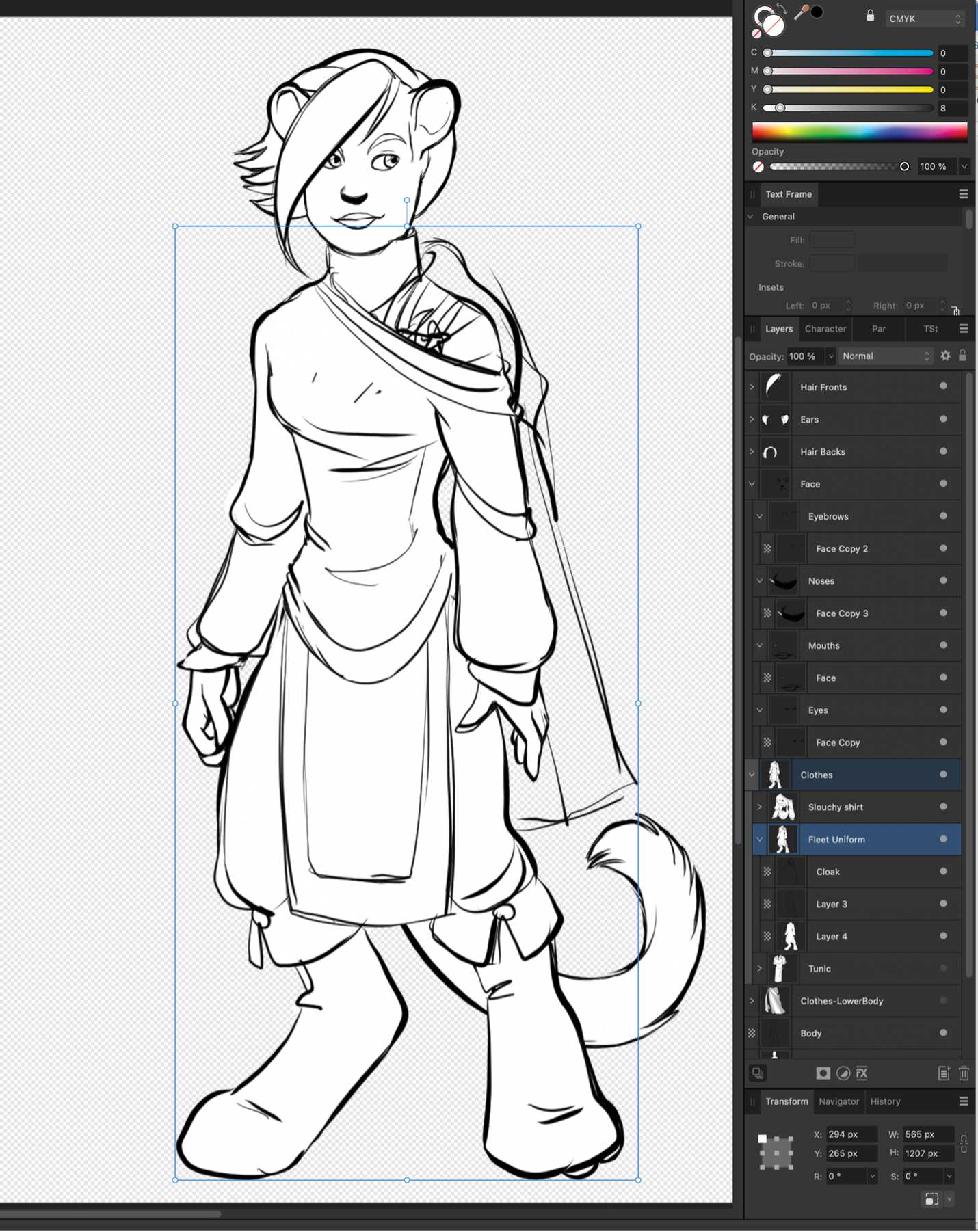
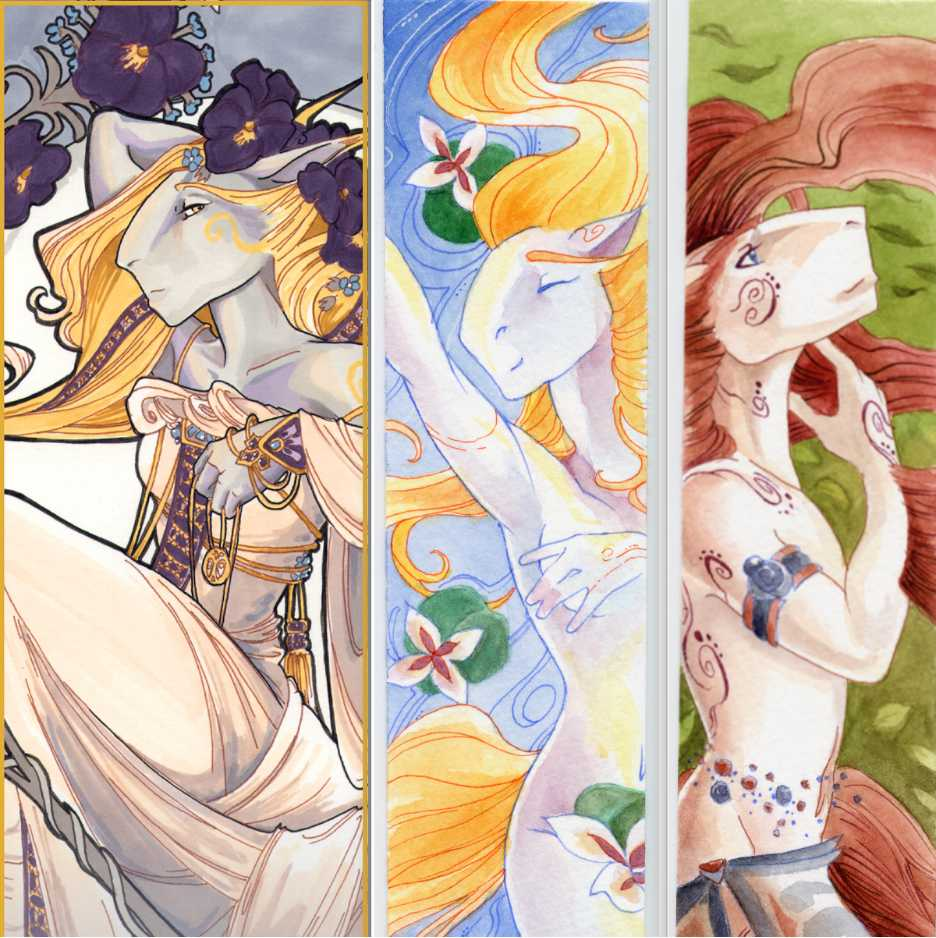
The answer to that, when I put it that way, was clear. I have been selling artwork of the Jokka for years before I sold a story about them (the first professional story I ever sold). And the Jokka novels and short stories are an emotional roller coaster, one not all readers are up for—they’re less entertainment and more art. But if I made a game about them, then I could make use of the design work I put into them, and the worldbuilding I poured into the world... maybe some of the game’s players might look into the stories, and maybe they wouldn’t, but the Jokka would live again in a new medium. Maybe it might even be the medium they’ll be best suited for!
Would the Jokka work for the game genre I'd chosen, though? I went down a mental checklist:
the setting is deep enough, in terms of how much work went into it… but also narrow in scope: all the stories take place within the same bronze-to-iron age of their world, in one very small area on their world, within one single society
the breeding mechanic makes sense since building and populating their clans and world was a big issue for them
…but they’re not human, so it won’t seem too weird to be trading people back and forth and breeding for stats and looks
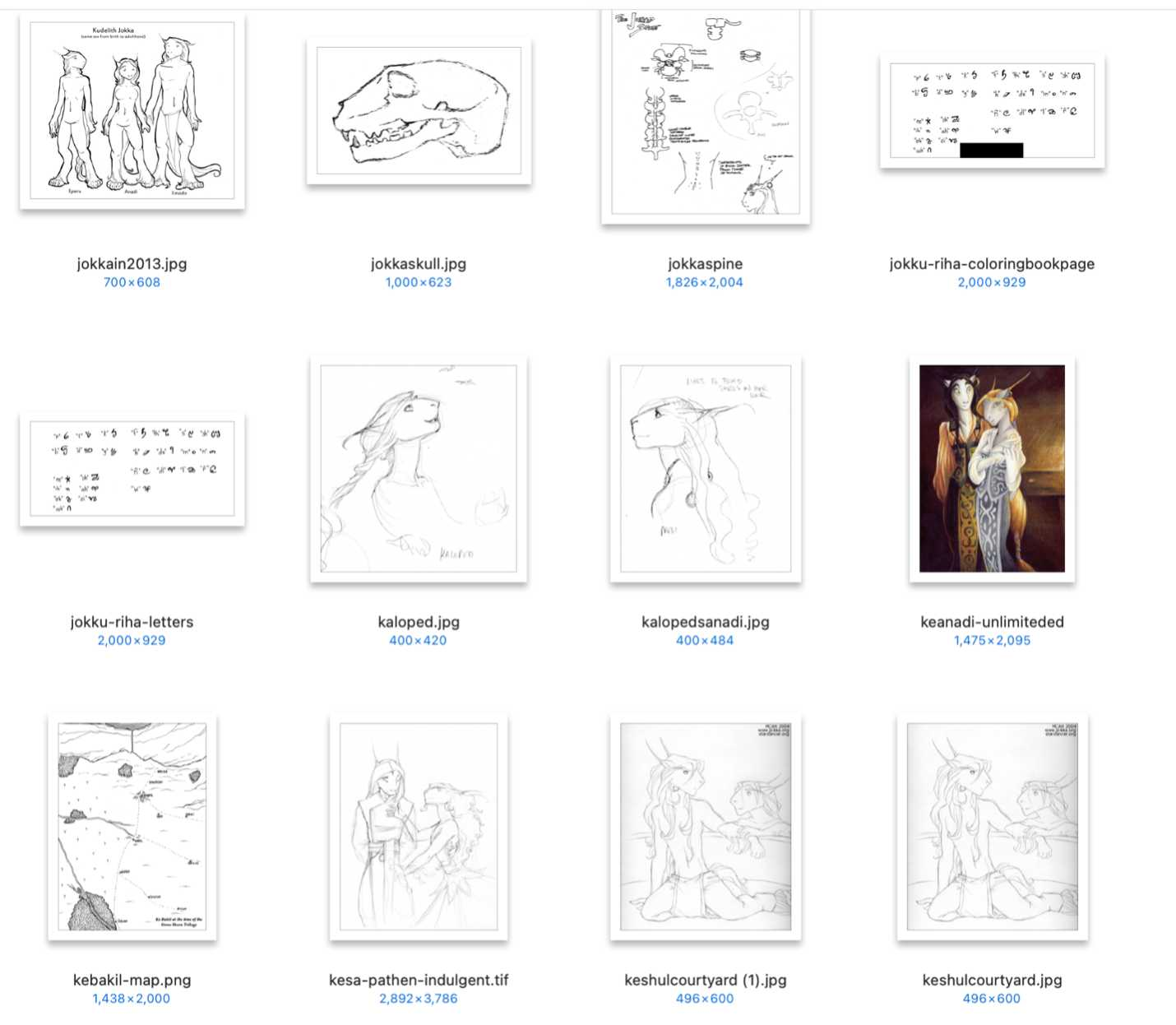
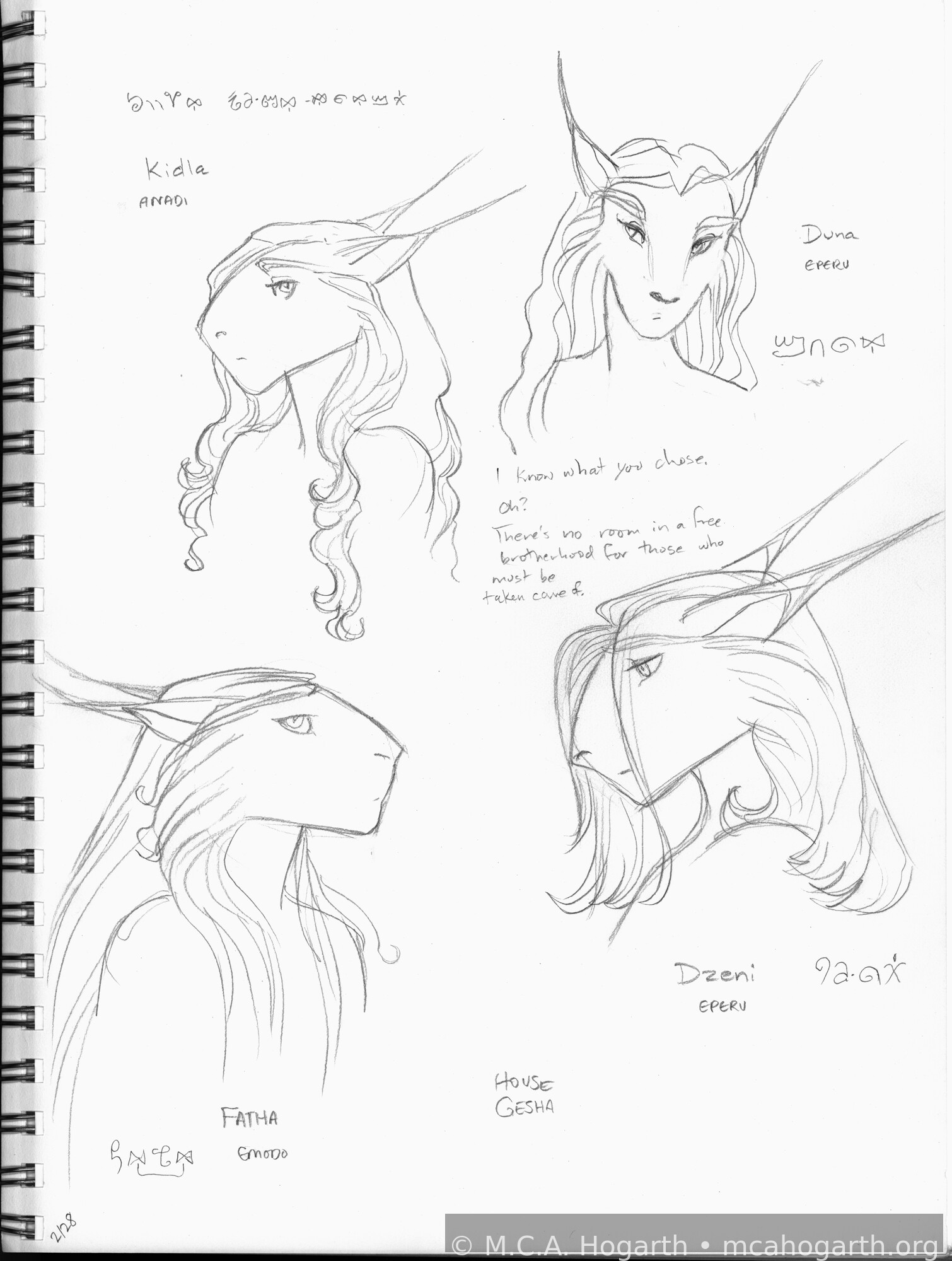
there’s lots of background material, visually, for me to work from
there’s lots of material I can use for bonus material, special events, and quests, using the stories as reference
Which is how I landed on the idea: a breeding/clan management simulator where you take your bronze age Jokka clan from founding to success, whatever success means for you! Collect pretty Jokka! Dress them! Give them roles! Manage your clan resources! Conquer! (Okay, no fighting mechanics, so… Thrive!)
“That,” I told myself, “is the kind of game I would build. IF I were building a game, and you know that’s a big if, because I’m just messing around with toys online. No pressure!”
Next week, I’ll talk about my tools and set-up, and then we’ll dig into the journey. Wow, was there a lot going on. Every single day. Did I even sleep, I wonder… no wait, all that’s in the changelogs…!

Or at least, I intend it to be relaxing. Hopefully it delivers.
4:22 minutes
Materials:
In which I talk about the paper, the paint, and the experience of oils versus gouache. Fun stuff, will do more.
Thank you Locals supporters! Your contribution to my art war chest here is what's powering these experiments and videos. For now I'm keeping them public but I may start doing some subscriber-only videos if you all are interested.💖
Thanks for your comments yesterday on the business post... all very provocative, in a good way. I'll try to respond to all of them today.
Some Alysha misc now, since I'm gearing up for the results of the Kickstarter!
Petrov is giving away coupon codes for every book in the Alysha series (and has some leftover coupons for Marda and the business book). You can pick those up here (and please do! The books are bought already, someone should use them!) https://twitter.com/PetrovNeutrino/status/1457344535843987461
Our own @JudasComplex sent along a sample of the Faith in the Service audiobook, which I've attached for your delight! I... haven't had a chance to listen to it. Don't ask me about my past week and a half or so. Putting it here will guarantee I get to it.
After hearing the amused comments during the livestream, I went ahead and added all the ship type illustrations I have inked from the 90s to the wiki. Glory in the rampant adorableness of their anthropomorphic stylings! See those ...
A little comedy today, at least in the link. Transcript follows.
Hi, all. Welcome to this episode of The Jaguar’s Heart.
A while back I was introduced to a comedy sketch about Cuban coffee by a Mexican comedian, Gabriel Iglesias. ( The sketch begins with him greeting all his fellow Latinos and then backing up to say ‘but we’re all different, aren’t we’ which is a segue into a demonstration of how different Hispanics speak Spanish.
It is hilarious. First, because I am a Spanish speaker and a linguistics hobbyist, and his portrayal of various accents resonated with my experiences in trying to make sense of them myself… Not always easy, since from culture to culture, slang and accent are often totally different (and sometimes grammar! Spaniards use a grammatical construct that has died out in many other Spanish-speaking countries, the plural “you.”)
I also loved it because the Cuban coffee part is real. I grew up with Cubans. I know how we are....
One of the most common things I hear (and say) right now is "the asymmetry is the story." Here's one about how none of us are innocent of the sins we hate in others.
Hi, all. Welcome to this week’s episode of The Jaguar’s Heart.
It’s been weeks since the Baen’s Bar incident and I’m still thinking about it... because the longer I do, the more I feel, overwhelmingly, that it’s obvious that the problem is deeper than “this forum was saying stuff that offended us.” We have to back up to the glaring fact that people on opposite sides no longer consider each other human. Nothing I say will matter because the people disagreeing with me don’t think I’m human. They have denied my humanity; they have not bothered to listen to my beliefs, or have fake-listened to them in that way that people do when they’re so ready to prove you wrong that they’re only using your speech to provide talking points for their own ideas.
We have forgotten how to listen.
Increasingly, we have also ...
As I’m not a numbers person I rarely think about counting systems for worlds I’m building. In practice, when you're writing you don't often get into math. But if I was going to, the world of the Jokka would be a good target. So many of the Jokka I’ve written are either superlative organizers or impressive account-keepers... at least one was so good at business, it shaped the world, and another, in the recent novella, was actually making some of the first Jokku abacuses!
Despite this obvious opportunity, I didn’t think about number systems for them until I was drawing a clay tablet for the game and realized it needed scribbling on it. So I started scribbling. And once I started scribbling, I started thinking it through.
So here’s how the Jokka count, and how I walked through that process.
They have claws, which are great for making lines in clay (their first substrate for writing). So I went with the same kind of bars we’d find familiar: vertical swipes.
Then I thought about why a ...
One of the most underrated productivity hacks on my list of things that work is “fool yourself into doing it.” This is a skill I developed because I’m not very brave, and yet most of life requires courage. I survive this by telling myself I’m not actually going to do scary things while planning to do them.
For instance: I dislike travel. Every trip I’ve ever embarked on successfully has involved me telling myself I’m not actually going to follow through on it. “I’m just shopping for ticket prices, I’m not going to buy them.” “I can cancel these at any time, but I’m just looking at hotels in the area.” “I can always sell this hotel room to some con-goer who needs it, there’s no need to panic.” “I’m packing, but I can always back out. I’ll be out the money, but that’s fine!” “I am in the boarding tube, but I can always turn back and run a—okay, now it’s too late, might as well keep going.”
Once something’s fait accompli, I can relax and deal with it.
You can do this ...
It’s wild to me to realize that my generation was the first generation to grow up with computer games. I had to remind myself that when I was very young, there were no home computers and no consoles and no arcade games, and then, in my lifetime, that became a thing. I lived through that? I lived through that. And then I lived through the era before online multiplayer games and the internet and internet-enabled games!
Can you imagine a world without games? I can’t, and I was born and gamboled through a large part of my childhood without them. Without even the conception of them. Board games, sure. Card games, yes. Social games like bingo and charades… but nothing involving a screen.
So I grew up with the computer gaming industry. I played the first text adventure games, like Zork; me and my friends played on the first consoles, the Atari and the Intellivision, at one another’s houses; my family gathered around the Apple IIe to watch my father navigate the eerie green line art map of the first ...

Good news, patrons! The beta for the JOKKA! game is now open! You, as paying patrons, now have early access!
Over the weekend, I read a book that I’m 95% sure was AI-written. I’ve listened to people talk about how it’s done: you brainstorm characters and a plot with AI, prompt it for an outline, adjust the outline, prompt it to create character and setting guides… attach all that to your project, then tell it to write the first chapter. You adjust the chapter, add it to the project, then tell it to write the second, etc, until you get to the end. Then you tidy the whole thing and publish. The "rapid release" people either love this (because you can release a book in a day or two and do it again immediately) or hate it (because they can't keep up with people using this strategy with unaugmented human brains). But it's clearly a thing that's happening, and few people who do it are admitting it.
Reasons I thought this book was AI:
Every chapter ends with a weird wrap-up style: “Main Character had accomplished XY and Z. Tomorrow, he’d have to tackle AB and C. But for today: job well done.” And I do mean every chapter. At first I thought ‘maybe the author’s serializing this and needs to remind readers about what just happened” but when it’s doing overviews of what happens in the chapter at the end, it’s weird.
All the places give you a “movie set” feeling of being wooden facades. Like… ‘there’s a baker. He makes bread.’ Nothing else. Only bread is mentioned. Not even the kind of bread. There’s a weird lack of specificity to everything. The baker always has a ‘basket of bread’. Or occasionally, a basket of pastries. (No word on what kind.) Likewise, there is a blacksmith. We know he can make hammers, because the apprentice made one. But that’s it. No idea what else the blacksmith does for the town.
Then there’s suddenly spates of specificity. “I have these exotic spices that sound like a list generated for game inventory.” These specific things are never mentioned again.
The technobabble sounds like stuff Claude gives me as placeholders. “Mana structure efficiency at 45%. Suboptimal but holding.”
Similarly there are some odd verbal tics that repeat throughout the text, and they are suspiciously clever ones, like analogies that rely on an abstract and a concrete noun: “It tasted of cinnamon and regret.” “The tavern smelled of old ale and worry.” Even the title uses this phrasing. Authors can have verbal tics, of course, but I associate a lot of these with AI.
The supporting characters do the exact same things, as if they’re programmed NPCs. Celebrating an achievement? ‘We go to this exact same tavern, every time.’ Checking up on the main character? “You need food and rest.” (I can’t count the number of times this character suggested everyone have food and rest, in exactly those words. No variation.)
This one is hard to describe, but the characters have believable backstories that suggest depth, but these backstories do not inform how they interact with other characters. The nemesis becomes the protagonist’s friend based on a single interaction, and this backstory, while mentioned in subsequent chapters, causes no friction, for instance. It’s as if every character was created in isolation and the author can’t figure out how to make them combine.
Could this all be the work of an inexperienced author? Sure. But that tells me that we have trained AI to work off story templates that inexperienced authors also rely on. If you have decades of “write to market” advice that treat books as widgets with “story beats” and “character arcs” that can be abstracted into formulas, you shouldn’t be surprised when books start to sound alike. They already were, prior to AI, it’s just that AI makes creating them faster.
Did people like the AI-generated book? Well, it has over a hundred reviews and a 4.5 star average rating, and even on Goodreads, it's doing well, so the answer is: “Yes, it’s good enough.” Did the author confess to AI-writing it? No. Maybe he didn’t! But my guess is that he did.
Do I care about this? Not really. I didn’t enjoy reading it because it gave me the same feeling social media scrolling does, that I’ve eaten empty calorie food that’s programming my brain to repeat basic and uncreative patterns. But humans have always riffed off bad things to make better things and I can totally see someone using AI to generate a draft like this, and then completely overhauling it into something enjoyable.
I don’t write like this because I’m weird. I am constitutionally incapable of the ‘write to market’ formulaic approach (which is why I’m not on a yacht sailing to my property on the Riviera). Even my attempts at romance and litrpg novels veer off into directions that make them too odd (yes, I managed to make both these genres unprofitable). But I’m one of those capital-A artists that indies like to sneer at, and I’m happy that way. I can’t even do that right: I’m an Arteeste who doesn’t care if you’re using AI!
My audience was always going to be the weirdos who want to learn my conlangs and vanish into alien cultures so completely they leave no traces. That's you all! You're awesome.
But yeah, AI-written books. You might have already read one and not realized it. The name of this one, if you want to check it out, is below, and yes I paywalled it because I don't want to bother with drama.
Red Honey has wrapped up! I’m not sure what I’m going to serialize next, but I figured I’d take a breather for the rest of the year since there’s so little of it left. We’ll continue to have Back-in-Time Tuesdays every week, but Fridays will be a hodgepodge of whatever’s on my mind. And what’s on my mind today is the Jokka game, which my Discord crowd has convinced me to just call JOKKA! (I think with exclamation point. With exclamation point, right, you all?)
I think I last seriously wrote about this around my birthday so it’s been almost two months. A lot happens in two months when you’re directing AI to code for you.
The foremost thing I’ve learned is that I am perfectly positioned to take advantage of AI for coding, because I have these things going for me:
I used to write technical documentation for software
I can do project management
I can draw
I can write and have written many novels' worth of material for background
I have done some light coding work
I like gaming and have played many games mindfully, noting what I hate and what I enjoy
But the number one thing that makes this easy for me is: