Answering these questions one by one, in posts. So, @madamebadger mentioned the Jokka novels as having evocative titles... here's how I got those.
I wrote Shell back when I was operating on "titles as art" rather than "titles as marketing" notion. I was still in college, or not long out of it, and my primary sense of how to title works was leftover from English literature classes where short story titles, and poem titles, were about themes and artistic considerations, primarily. (I don't think this is wrong, it's just a different way to go about it; most genre short fiction is still titled this way because they aren't meant as standalone products.)
So I named the first book, The Worth of a Shell, after the theme of the novel, which was encapsulated by one of its final scenes. (No spoilers, hopefully, for those of you who haven't read it yet.)
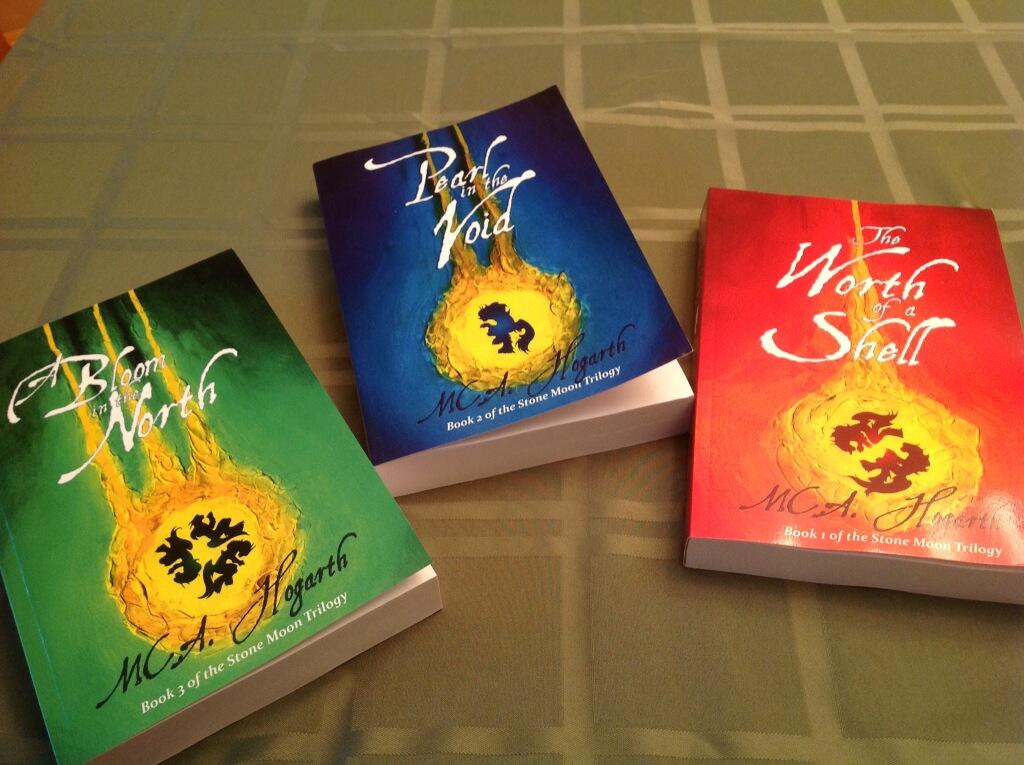
I didn't go back to finish that trilogy until long after I'd become my own publisher, which meant by then I was operating on the 'title as marketing' assumption. That meant all the titles in the series should sound like they belong together. I was stuck with Book 1's title, which wasn't too bad... so I decided to riff on that pattern:
[Article ] noun-related-to-theme [preposition] noun-relating-to-theme
I decided that the thematic images that worked best for Book 2 had to do with Keshul and his relationship to one of the gods (is he the literal pearl, or is something else? I leave that to people to decide). So now I had two:
The Worth of a Shell
Pearl in the Void
Then I needed the pattern again, and I wanted an indefinite article, because the first book had a definite one ("the worth) and the second one had no article. So I wanted 'a' or 'an'. I chose the thematic nouns, again, because they could be applied in multiple ways (which north? What is the bloom? Is it literal? Figurative?) and still be correct, and then went with the indefinite article to make that ambiguity more distinct:
A Bloom in the North
So all the titles have the same rhythm (one-syllable-word beat beat one-syllable-word), with the same structure (noun prepositional link noun), and with rotating articles.
Something you'll notice is that when I was doing the 'title as poetry/literature', the title is a literal callback to something said in the novel. But the later two titles are both a lot less direct; they're not supposed to act like the title of a poem (which often points you at the conclusion/idea you're supposed to take away). They leave a lot more up to the reader, interpretation-wise. There's really only one way to understand The Worth of a Shell from the book's context, but both Pearl and Bloom let you, the reader, decide what the titles mean to you.
I don't think either kind of title is better or worse. It's just a different way of doing things. (And I think that 'title as conclusion/thematic pointer' works better in shorter pieces of art that the reader is more likely to be able to keep entirely 'in memory', so to speak.) I do think the 'all books in a series should have a pattern' is really important, though, and that's something I didn't learn until later.
In terms of the short story collection, it's both a literal in-world reference (early Jokka set out stories with stones painted with letters, stone by stone, outdoors for people to read)... and meant to be evocative (it just sort of sounds cool). It follows the same pattern as the novels (NOUN (preposition) NOUN). And, I had notes that any additional collections should be similar: "Clays Beneath the Sun", "Clays Along the Seas", etc.
Lagniappe: I have no idea if the Jokka covers sell or don't sell the books, and I'm not inclined to change them because they do well enough. But notice that Shell, which is about the relationship between two people, and about the Anadi and the Eperu impulses in society, has the two Jokka on the front cover... but there's only one "trail" away from the medallion they're on top of, because that's how precarious their connection to society was. Pearl has only one Jokkad on the cover because it was about the isolation of one person and his mission, and primarily about the Male actors in society... but his medallion has two trails, because he was connected twice to society, through Roika and the Void. And the final book has three Jokka, because it was about the harmonizing of all three sexes in society, and it has all three trails leading from the medallion, because religion, society, and personal affairs were finally healthfully established.
I suppose one day I might update the covers. But not a priority.