studiomcah
Art • Books • Writing
Community for science fiction and fantasy author/artist M.C.A. Hogarth.
Interested? Want to learn more about the community?
November 12, 2021
The Anatomy of a Successful Fiction Kickstarter

This post ran on Kickstarter on Wednesday and was locked to backers only, but we hit our stretch goal later that day and I feel that it's too good a post to leave locked forever. So I am reprinting it here (without modification) for people to consult in the future. :)


Good morning, backers! Today we are at a stunning 386% funded, with about 48 hours to go! We really are in the homestretch now, which makes it a good time to tell you why I don’t expect us to garner any more money!

And it has to do… with METRICS.

This is a super crunchy business post, which means only backers will get it. Thank you for backing, and if you want to share it so that other people will toss in a buck to read it, I think it'll be worth it.😊

LET'S TALK AUDIENCe

Most of you know I’ve completed 18 successful Kickstarters. Of those, 13 were fiction projects, and the remainder art. This distinction matters because few things are as apt to attract random backers as fiction projects. Most other crowdfunding campaigns are easy for browsers to evaluate: an art project can be gauged within a few seconds, a music/film project might require the commitment of a couple of minutes of listening/viewing to samples… projects based on nonfiction topics will draw people based on their topics, and product-based Kickstarters have natural audiences.

Fiction, though, is a very hard sell. If you’re an established author, you’re asking people to spend more than a few minutes reading samples to see if they’re interested; if you’re a new author, you’re asking people to trust that you’ll deliver. It is, in short, the wrong tool for attracting new backers, which is why most of the successful fiction Kickstarters you’ve heard of… you’ve heard of. Because their authors are well-known.

For this reason, I never target fiction campaigns at strangers. They’re intended not just for my readers, but for the super-patrons who are aware of crowdfunding at all, and are familiar and comfortable with being online. This isn’t even 10% of my readership… it’s more like 3-5%. And complete strangers who have never heard of me? I’m surprised if even 1 in a hundred backers turn out to be newbies.

So the first factor in gauging the potential success of a fiction Kickstarter is understanding your target audience: the subset of your existing fans who are likely to notice that you have something going on that’s not the latest release of a book at retail.

Next factor?

LET'S TALK SET-UP

Given that, the next most important factor is how you set up the project. Knowing what you want to achieve and how much time you have to spend on it are of paramount importance here. When I design one of these, here are the inputs to my thinking:

  • How long do I want to spend in fulfillment? As a single-person business that makes money by producing creative content, my main activity should be… producing creative content. I don’t want to spend months hip-deep in packages and spreadsheets. I choose each prize I offer based on how long it will take me to craft and send it.
  • What can I afford to offer? Every prize has to make back its Kickstarter cost before it can contribute to the cost of the content I’m trying to produce. By Kickstarter cost, I mean not just the monetary cost of producing the prize, but the time I spend researching it and fulfilling it. (This means that new prizes are more costly than ones I’ve done before because I need to do the legwork of figuring out whether people want them, how to produce them, how to price them, etc.)
  • How much money do I need? Yes, this is the last consideration. Does that sound strange? But it doesn’t matter how much you need if you don’t have the overhead to run the project. You have to know first what you can commit to the campaign before you can set your monetary target… and if you don’t have the resources to get you to the number you need, then… you can’t run the project.

Worth repeating: if you need $10,000 and you can only spare $2000 worth of time, money, and effort… then you can’t run the project. Your resources limit what you can accomplish.

But Jaguar! I hear you saying. Isn’t the point of Kickstarter to get the resources you don’t have?

And I say: the only thing a Kickstarter will deliver is money. Not all problems can be solved by money. Thinking that with enough of it you’ll be able to handle anything is naïve. That project that asked for $5000 and got $500,000? “Oh, I’ll just hire people to help me!” But have you tried to hire anyone? Do you know what’s involved? How will you pay them? What if they flake? Have you tried ordering $500,000 worth of anything? It’s not much like $5000 worth of anything. Do you even know where you’ll put all those pallets when they arrive at your house?

So many problems. If your goal is to continue to do the thing that matters to you (in my case, produce creative content), then don’t put yourself in a situation where your job becomes ‘I consult spreadsheets, pack things, and ship things for a living.’

Let’s return to this project, then, and have a look at some statistics.

JAGUAR PREDICTIONS

Let's haul out the charts!

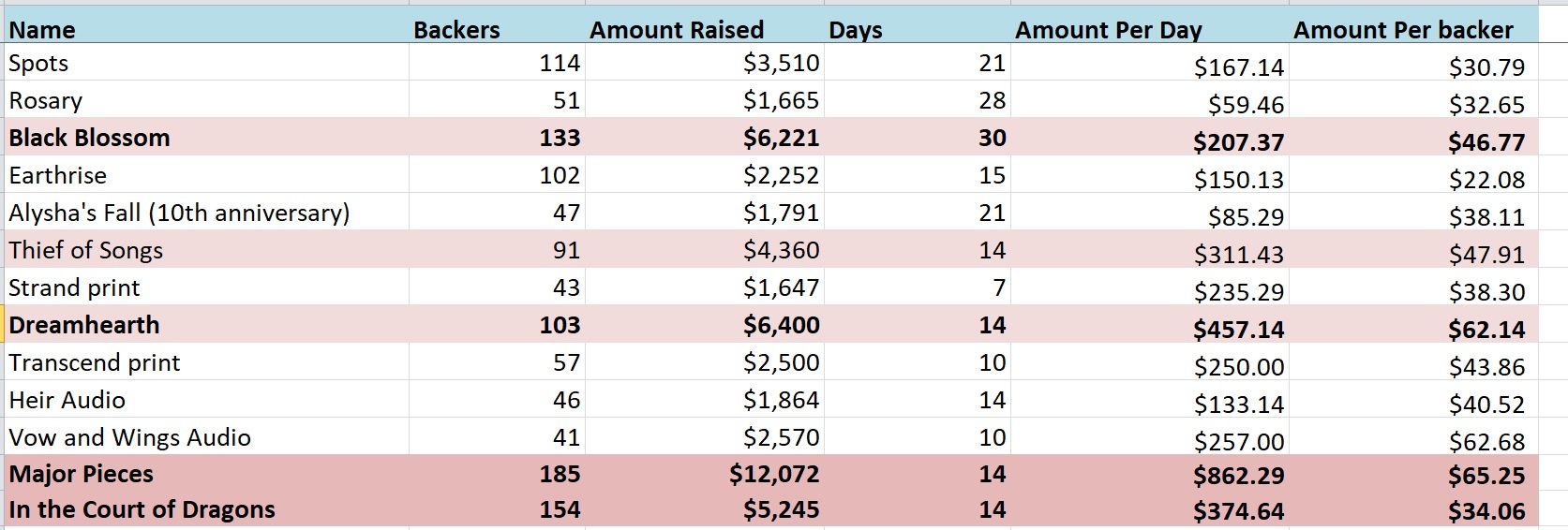
My typical fiction Kickstarter (audience: existing super-patrons; resource allocation: low; target-to-fund: low) is designed to get me very close to exactly the amount I’m asking for (usually $1000-1500). I plan to sign and draw in 25 books. This takes me 5-15 days, which I feel is a reasonable time allocation, and if all 25 sell, I’ll hit the goal. I throw in a $1000 original art tier because it’s never a bad thing to aim high, and my original art tiers usually sell. The unlimited ebook tier usually brings me some gravy, but most of my money will be made on the autographed books because the Kickstarter is aimed at super-patrons who value collector’s items, and a $10 ebook is more of a casual browser prize.

Based on this design, I predict that most of my fiction Kickstarters will earn me about $2000ish, and I’ll wrap them up within a month. As you can see from the data, this is usually what happens. The average here is skewed a bit because of a few heavy-hitting projects (which I'll discuss under Wild Cards), but in general I have a sense of how many people to expect and how much they're going to contribute.

The best part of managing your time and expectations is that you can run multiple Kickstarters with little effort. Unlike the famous writer who ends up with the $100,000 Kickstarter they need a year and a half to manage, you can drop 2-4 Kickstarters a year if you wanted, and still have plenty of time to write.
averages

That brings us to this project! This time around I need more money, so I designed accordingly. The 25 autographed books that would usually have gotten me over the $1500 target, plus the $1000 original art tier that would probably go, would only get me to $2500. So I designed six more premium prizes, based on cameos: five $250 minor cameos, and one $1000 one. The latter was a gamble—I wasn’t sure it would fly—but I was fairly confident that the minor cameos would pick up some backers, and if all five of them went, I’d add another $1250 to the total, which gets me very close to my $4K target.

It’s important to remember, designing projects, that nothing is ever certain. People’s monetary situations change, and readers come and go… so there’s never a guarantee that because you sold out a certain prize before, you will again. But you have to design and pitch the project as if it can succeed if you want it to have legs…! So I did, and thought that at most, it would bring in about $5000. That it’s at $7600 right now honestly is a surprise, which brings me to my last discussion here…

WILD CARDS

If a project succeeds beyond my projections, it’s always because of a wild card, and that wild card is invariably one person, or maybe two, who feel strongly about that particular piece of fiction. You can offer all the stretch goals you want, but in my experience the single biggest mover in a fiction Kickstarter is that one super-patron who really loves that project. (This is another reason why it’s good to use Kickstarter for existing work, rather than new work.) Again, I am talking strictly about fiction here… when your stretch goals are ‘unlock a new plush animal design!’ or ‘at this ridiculous amount I will design an entire new set of cloisonné pins!’ then you can get strangers piling in on your project to propel it to the stratosphere. Novels are a different ball of wax.

Because fiction Kickstarters break expectations based on whether a few people really love the content, I’ve found it useful to give them something to aim for: invariably new content. In the Major Pieces and Court of Dragons projects, that new content was ‘more short stories’; in the Dreamhearth project, it was ‘an entirely new novel.’ (Even Black Blossom offered new content, in the form of shorts; those are now in the back of the second edition.) For this project, I looked at my writing schedule and decided that an extra $5k would be enough money to pay for my time writing a book I didn’t have on the schedule for another year and a half. That gave me $10K as a goal for adding a second book as a prize. If we hit $10K, it will be because one or two people love the Alysha stories enough to push us to that ceiling, at which point we will stop funding.

So: keep an eye on the totals from here on out. If we jump up to $10K, particularly on the last day, you’ll know it’s because someone—at most two or three people, but historically it’s one person—wants that second Alysha book and has the money to make it happen.

CONCLUSION

There are a few things I’d like you to take away from this post, then:

  • First, keeping statistics is enormously helpful. Start with your first project (or first anything you’re selling). Your predictions won’t be trustworthy until you have enough data, but committing to tracking the information will change how you approach your projects… and for a lot of people, it inspires confidence, because you feel like you’re in control of your assumptions and projections.
  • Second, designing your project to hit the target is important and rarely emphasized. If you’re asking for $2000, make sure you have $2000 worth of stuff that you can deliver in a timely way. Don’t leave this part up to chance. Run the numbers.
  • And third… when I am excited about a project doing well, I mean it. I’ve backed… checks 128 projects over the years, and I’ve often been reduced to tossing in a dollar to show my support instead of backing for the prize I really wanted. I never assume that my patrons are flush in the pocket at the moment I show up asking for support; and I never feel entitled to their money, particularly in instances where they are overpaying for a product to help produce it. Someone giving you $10 for an ebook you both know will sell at retail a few months later for $5 is a gift, and it’s right to be grateful for it. And project overfunding is inevitably the result of super-patrons wanting to show you how much your work means to you. That’s always special, and if I seem hyper-excited about it, it’s because I think it’s worthy of hyper excitement.

That’s all I’ve got today, backers! We’re into the final 48 hours, and as you now know, I don’t expect any significant movement until Friday, near project close! We’ll see what happens… together! Until tomorrow, then… thank you for your support.❤️


Interested? Want to learn more about the community?
What else you may like…
Videos
Podcasts
Posts
Articles
October 27, 2021
Cursive Practice Video, to Relax

Or at least, I intend it to be relaxing. Hopefully it delivers.
4:22 minutes

Materials:

00:04:27
Overview of the First Oil Paint Experiment

In which I talk about the paper, the paint, and the experience of oils versus gouache. Fun stuff, will do more.

Thank you Locals supporters! Your contribution to my art war chest here is what's powering these experiments and videos. For now I'm keeping them public but I may start doing some subscriber-only videos if you all are interested.💖

00:03:35
Video Review: Oil Painting Papers

My initial review on receipt of the three oil paper products I ordered: the Canson pad, the Rembrandt block, and the Arches single sheets.

00:01:54
November 09, 2021
Alysha Misc

Thanks for your comments yesterday on the business post... all very provocative, in a good way. I'll try to respond to all of them today.

Some Alysha misc now, since I'm gearing up for the results of the Kickstarter!

Petrov is giving away coupon codes for every book in the Alysha series (and has some leftover coupons for Marda and the business book). You can pick those up here (and please do! The books are bought already, someone should use them!) https://twitter.com/PetrovNeutrino/status/1457344535843987461

Our own @JudasComplex sent along a sample of the Faith in the Service audiobook, which I've attached for your delight! I... haven't had a chance to listen to it. Don't ask me about my past week and a half or so. Putting it here will guarantee I get to it.

After hearing the amused comments during the livestream, I went ahead and added all the ship type illustrations I have inked from the 90s to the wiki. Glory in the rampant adorableness of their anthropomorphic stylings! See those ...

Alysha Misc
The Jaguar's Heart 7: We Are Not a Monolith

A little comedy today, at least in the link. Transcript follows.


Hi, all. Welcome to this episode of The Jaguar’s Heart.

A while back I was introduced to a comedy sketch about Cuban coffee by a Mexican comedian, Gabriel Iglesias. ( The sketch begins with him greeting all his fellow Latinos and then backing up to say ‘but we’re all different, aren’t we’ which is a segue into a demonstration of how different Hispanics speak Spanish.

It is hilarious. First, because I am a Spanish speaker and a linguistics hobbyist, and his portrayal of various accents resonated with my experiences in trying to make sense of them myself… Not always easy, since from culture to culture, slang and accent are often totally different (and sometimes grammar! Spaniards use a grammatical construct that has died out in many other Spanish-speaking countries, the plural “you.”)

I also loved it because the Cuban coffee part is real. I grew up with Cubans. I know how we are....

The Jaguar's Heart 7: We Are Not a Monolith
The Jaguar's Heart 6: Hatespeech

One of the most common things I hear (and say) right now is "the asymmetry is the story." Here's one about how none of us are innocent of the sins we hate in others.


Hi, all. Welcome to this week’s episode of The Jaguar’s Heart.

It’s been weeks since the Baen’s Bar incident and I’m still thinking about it... because the longer I do, the more I feel, overwhelmingly, that it’s obvious that the problem is deeper than “this forum was saying stuff that offended us.” We have to back up to the glaring fact that people on opposite sides no longer consider each other human. Nothing I say will matter because the people disagreeing with me don’t think I’m human. They have denied my humanity; they have not bothered to listen to my beliefs, or have fake-listened to them in that way that people do when they’re so ready to prove you wrong that they’re only using your speech to provide talking points for their own ideas.

We have forgotten how to listen.

Increasingly, we have also ...

The Jaguar's Heart 6: Hatespeech
Artwork, Step By Step

I couldn't resist iterating the gallery a little now that so many of you are visiting it, so I implemented the versioning system that lets you see every stage of a piece I've done, from beginning to final, if I have it. And I do, for a lot of the older Stardancer stuff! So I'm restoring it as I have time.

There's also a search filter for 'is finished' (along with 'has versions' and 'has commentary').

I'm looking forward to uploading all the finished art, and the stuff I can restore from backup, as I have time! In the meantime, go have a look at the stages of the haiku, they're fun! I even found most of the ancient commentary from the database.🧡

https://mcahogarth.org/gallery/image/65-2001-030-Haiku2FantasyReality-v2

Gamedev Diary: Testing All The Way

Going back through the earliest conversations about the development of JOKKA! Made me realize that… they were conversations. I didn’t know how strange this was until I started reading and researching gamedev, because inevitably there’s a chapter about alpha testing. It always starts with something like “Here’s how you find alpha testers!” and “here’s how you collect data!” and “here’s how you reconcile user feedback with the game you’ve spent months developing in your fortress of solitude!”

What was I doing from the very beginning? “Look, here’s my toy! It’s online! Come poke it!”

Obviously, this is an artifact of having chosen to develop a web-first game; it’s a lot harder to have this kind of interaction if your game is desktop or console-based. But I did what I did, and because of that, from the very beginning, I was working with alpha tester feedback. There are conversations with 10+ people asking me questions, reporting something weird, telling me what would be fun...

post photo preview
Wednesday Art Share!

The gallery is open! I will do a formal launch post next week. But my new Patreon feature is the Wednesday Art Share, which is a community participation thing! Please share your newest favorite art in the comments so other gallery users can add to their hoards! Just drop the URL (or if you want, talk about why you picked it!)

Make a free account to see the full-sized image. Or, if you're a paying subscriber, go get your access code for unlimited access to the whole archive, which is 2100 images strong now, and growing. It's pinned. :)

Let's see your shinies! Here's my pick today:

https://mcahogarth.org/gallery/image/143-2026-14-ChatcaavaNouveau

Early Access is Now Live! Come Join Us on Ke Bakil!
Make your own Jokka clan and watch it thrive!

Good news, patrons! The beta for the JOKKA! game is now open! You, as paying patrons, now have early access!

Only for Supporters
To read the rest of this article and access other paid content, you must be a supporter
Read full Article
Welcome Back, to the Stardancer Gallery

I have a gallery again.

It would be so easy to say ‘I can’t tell you what that means to me’ but part of my thing is that I do tell you what things mean to me, all the time, so I’m going to try.

1.png?token-hash=nrdoS5Y9_iiERRaTSKIzbGY-dtyGgI1XVmNbDQ3zMz0%3D&token-time=1784764800
mcahogarth.org

Let me start by telling you about the original Stardancer gallery, which many of you remember and an even larger number of you weren’t around for. Because in an era before big sites like DeviantArt, when personal websites were still linked by webrings and coded by hand, I had a website that used a database to show visitors not only the latest thing I’d uploaded, but the comments left by dozens of people on that offering.

It’s so hard to explain how crazy that was. There were no Wordpress packages, no visual editors, no gallery plugins. There was no user validation by Google or Apple, no social media, no expectation of interaction or community. Everything had to be coded by hand and installed by someone who wasn’t afraid of a UNIX command line. And from 1999 until mid-2012, the Stardancer gallery served, on average, 5 pieces of art a week, with over 175,000 words of commentary from me, for thirteen years, and those pieces accrued between 5 to 40 comments from visitors. When it finally went down, there were 2906 distinct pieces of art in the database, and of those 253 had multiple versions—I uploaded them as I worked on them with commentary on each stage. Some of those pieces had 9-10+ stages where you could watch me wrestling with them (complete with titles like “OMG Ugly Stage” and “needs a background”).

For context, 175,000 words is probably about 700 tightly-packed paperback pages. That’s how much commentary I wrote. And that’s not including 1993 keywords and 60 projects I was tagging everything with.

I wanted that gallery so I could share my art with all of you. But it was also functioning as an organizational layer for me. When I was trying to remember a story, a character name, a forgotten piece of art I wanted to finish, I would search my own gallery. It was my backup brain, and my sketchbook index, and it kept me focused. It even had basic project management tools, since each of those 60 projects had a status: complete, in progress, ongoing, on hold, trunked.

The sunsetting of the original site was inevitable. You can’t run software with visions of enterprise-level functionality on a friend’s personal computer. But I was in the very unusual position of having started out with a system custom-built for my idiosyncrasies, and nothing on the market was good enough. I kept poking and not loving any of my choices. Host all my artwork on some aggregate gallery site or shoehorn it into a cookie-cutter Content Management System? No thank you. So I never replaced Stardancer, and for fourteen years, I’ve been running without that second-brain infrastructure.

And now, I have it again.

Now I can think ‘what was that thing I said about that one character in that one sketchbook?’ and search and find it. I can mutter, “Where is all the Ai-Naidari language work” and pull up the notebook. I can think ‘Didn’t I want to finish that picture of the dala fox? What sketchbook is that in?’ and I know.

I know!

And unlike the first gallery, this one can have everything in every sketchbook. Because I streamlined the parts I hate (editing, watermarking, uploading, making thumbnails, importing into the database) and left myself only the parts I enjoy (writing comments and tagging). And while some of the original Stardancer’s features aren’t online yet, like multiple versions of the same image, they’re designed and in the queue… and this version can have cool new features, like user favorites, and requests from users who love something and want me to finish it.

I’m so forgetful. I keep trying to explain to people how much of a cheesecloth my brain is with just about everything. Without rigorous documentation, lists, and notebooks, I would be completely useless. Art is one of those places I document my thoughts and keep myself pointed in the right direction. The fourteen years I didn’t have a gallery are literally gone in my brain, artistically. I have to dig up the physical books and thumb through them to remember anything about them. So I think you can imagine my relief that this is now available… not just for you to enjoy. But for my sake, to keep myself from vanishing because I am no longer observing myself.

Right now the new gallery has 2644 images across the 42 sketchbooks (and one unfinished language notebook) I’ve scanned and uploaded… of the nearly 200 I have. I’m only just getting started. I am crazy excited, I can’t even tell you.

I have a gallery again.

I have a gallery again!

1.png?token-hash=OFM2le6FWSQrplCYRdqaQS9LfErLYuCE_NXNeyl-5I0%3D&token-time=1784764800
mcahogarth.org

Anyway, this is the part where I talk about how you can enjoy the gallery:

Every subscription and purchase helps keep the gallery open and supports our free users, so thank you so much for chipping in!

What can I say? Welcome home, my friends. Welcome back!

Read full Article
December 10, 2025
The Jaguar Reads an AI-Written Book

Over the weekend, I read a book that I’m 95% sure was AI-written. I’ve listened to people talk about how it’s done: you brainstorm characters and a plot with AI, prompt it for an outline, adjust the outline, prompt it to create character and setting guides… attach all that to your project, then tell it to write the first chapter. You adjust the chapter, add it to the project, then tell it to write the second, etc, until you get to the end. Then you tidy the whole thing and publish. The "rapid release" people either love this (because you can release a book in a day or two and do it again immediately) or hate it (because they can't keep up with people using this strategy with unaugmented human brains). But it's clearly a thing that's happening, and few people who do it are admitting it.

Reasons I thought this book was AI:

  • Every chapter ends with a weird wrap-up style: “Main Character had accomplished XY and Z. Tomorrow, he’d have to tackle AB and C. But for today: job well done.” And I do mean every chapter. At first I thought ‘maybe the author’s serializing this and needs to remind readers about what just happened” but when it’s doing overviews of what happens in the chapter at the end, it’s weird.

  • All the places give you a “movie set” feeling of being wooden facades. Like… ‘there’s a baker. He makes bread.’ Nothing else. Only bread is mentioned. Not even the kind of bread. There’s a weird lack of specificity to everything. The baker always has a ‘basket of bread’. Or occasionally, a basket of pastries. (No word on what kind.) Likewise, there is a blacksmith. We know he can make hammers, because the apprentice made one. But that’s it. No idea what else the blacksmith does for the town.

  • Then there’s suddenly spates of specificity. “I have these exotic spices that sound like a list generated for game inventory.” These specific things are never mentioned again.

  • The technobabble sounds like stuff Claude gives me as placeholders. “Mana structure efficiency at 45%. Suboptimal but holding.”

  • Similarly there are some odd verbal tics that repeat throughout the text, and they are suspiciously clever ones, like analogies that rely on an abstract and a concrete noun: “It tasted of cinnamon and regret.” “The tavern smelled of old ale and worry.” Even the title uses this phrasing. Authors can have verbal tics, of course, but I associate a lot of these with AI.

  • The supporting characters do the exact same things, as if they’re programmed NPCs. Celebrating an achievement? ‘We go to this exact same tavern, every time.’  Checking up on the main character? “You need food and rest.” (I can’t count the number of times this character suggested everyone have food and rest, in exactly those words. No variation.)

  • This one is hard to describe, but the characters have believable backstories that suggest depth, but these backstories do not inform how they interact with other characters. The nemesis becomes the protagonist’s friend based on a single interaction, and this backstory, while mentioned in subsequent chapters, causes no friction, for instance. It’s as if every character was created in isolation and the author can’t figure out how to make them combine.

Could this all be the work of an inexperienced author? Sure. But that tells me that we have trained AI to work off story templates that inexperienced authors also rely on. If you have decades of “write to market” advice that treat books as widgets with “story beats” and “character arcs” that can be abstracted into formulas, you shouldn’t be surprised when books start to sound alike. They already were, prior to AI, it’s just that AI makes creating them faster.

Did people like the AI-generated book? Well, it has over a hundred reviews and a 4.5 star average rating, and even on Goodreads, it's doing well, so the answer is: “Yes, it’s good enough.” Did the author confess to AI-writing it? No. Maybe he didn’t! But my guess is that he did.

Do I care about this? Not really. I didn’t enjoy reading it because it gave me the same feeling social media scrolling does, that I’ve eaten empty calorie food that’s programming my brain to repeat basic and uncreative patterns. But humans have always riffed off bad things to make better things and I can totally see someone using AI to generate a draft like this, and then completely overhauling it into something enjoyable.

I don’t write like this because I’m weird. I am constitutionally incapable of the ‘write to market’ formulaic approach (which is why I’m not on a yacht sailing to my property on the Riviera). Even my attempts at romance and litrpg novels veer off into directions that make them too odd (yes, I managed to make both these genres unprofitable). But I’m one of those capital-A artists that indies like to sneer at, and I’m happy that way. I can’t even do that right: I’m an Arteeste who doesn’t care if you’re using AI!

My audience was always going to be the weirdos who want to learn my conlangs and vanish into alien cultures so completely they leave no traces. That's you all! You're awesome.

But yeah, AI-written books. You might have already read one and not realized it. The name of this one, if you want to check it out, is below, and yes I paywalled it because I don't want to bother with drama.

Only for Supporters
To read the rest of this article and access other paid content, you must be a supporter
Read full Article
See More
Available on mobile and TV devices
google store google store app store app store
google store google store app tv store app tv store amazon store amazon store roku store roku store
Powered by Locals